

What Is a Lumber Takeoff and Why Does It Matter?
A lumber takeoff is the process of measuring and counting the lumber and framing materials needed for a construction project using its blueprints. It identifies quantities, dimensions, and specifications for materials such as studs, joists, headers, plywood, and OSB before ordering.
For contractors and builders, an accurate lumber takeoff helps reduce ordering errors, identify missing materials, and prepare for purchasing and delivery. Using outdated plans or incorrect measurements can lead to shortages, excess materials, and construction delays.
Sorrento Lumber & Concrete supplies lumber and framing materials and offers blueprint estimating assistance for Louisiana construction projects.
Lumber Takeoff Assistance
Have Building Plans? Let’s Work Up Your Lumber List.
Don’t start ordering framing materials from rough guesses. Sorrento Lumber & Concrete can help work up a materials list from your current plans. Contact our lumber team to discuss your project requirements.
Discuss Your Lumber TakeoffWhat Is a Lumber Takeoff?
A lumber takeoff is the process of measuring and counting lumber and related framing materials shown in construction plans.
Also called a framing takeoff or material takeoff, it helps determine what materials a project requires before quantities are priced or ordered.
Depending on the project, a takeoff may identify:
- Wall studs and plates
- Headers and blocking
- Floor joists and framing members
- Roof framing components
- Plywood and OSB sheathing
- Treated lumber
- Connectors and other specified framing materials
Each item should be identified by quantity, dimensions, and relevant specifications.
The result is a construction material list that provides a basis for estimating and purchasing. It does not replace the project’s structural design or approved construction documents.
What Is Included in a Framing Takeoff?
A framing takeoff should reflect the actual construction scope rather than a standard list used for every job.
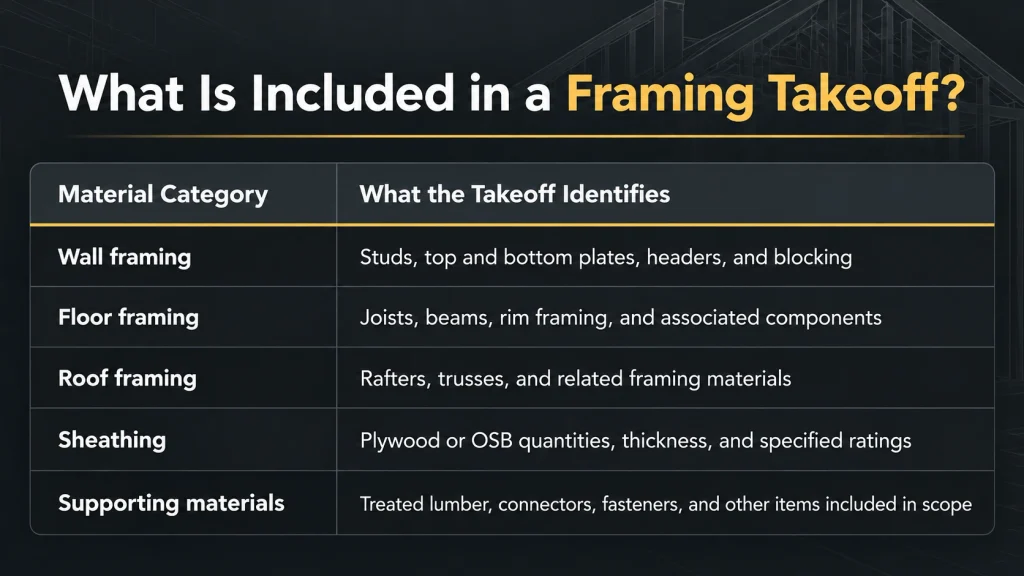
Quantities may be recorded as individual pieces, linear feet, or square feet, depending on the material.
For sheathing, the quantity alone is not enough. The specification may also require a particular panel performance category, span rating, or exposure classification.
The APA Rated Sheathing specification guide explains these product characteristics.
How Is a Lumber Takeoff Prepared From Construction Plans?
A reliable takeoff follows a consistent process, beginning with the correct drawings.
1. Review the Current Plans and Specifications
Start with the latest available architectural and structural drawings.
Depending on the project, these may include floor plans, framing layouts, wall sections, roof plans, schedules, and structural details.
Confirm the drawing issue date and revision number.
An outdated plan set may produce quantities that no longer reflect the approved project.
Procore’s guidance on drawings for takeoffs highlights the importance of drawing scale and reviewing measurements when revisions occur.
2. Measure and Count the Required Materials
The estimator measures framing lengths, counts components, and identifies materials from the drawings.
The takeoff should account for differences in:
- Lumber dimensions and lengths
- Framing spacing
- Wall heights and openings
- Floor and roof layouts
- Specified material grades
- Treatment and exposure requirements
Structural sizes and spacing must follow the applicable design documents.
The American Wood Council’s Wood Frame Construction Manual provides technical design guidance for wood-frame construction. It should not be treated as a substitute for the project’s engineering requirements.
3. Organize the Construction Material List
Once quantities are measured, organize the materials by type, size, grade, and quantity.
Separate items that have different specifications, even when their dimensions appear similar.
For example, treated and untreated lumber should not be combined into one purchasing line if the plans require different uses.
An organized list makes it easier to review quantities, request pricing, and identify materials requiring further clarification.
4. Review Waste, Revisions, and Substitutions
A takeoff should also identify reasonable allowances for cutting, handling, and project-specific waste.
There is no universal waste percentage appropriate for every lumber project.
Waste depends on member lengths, cutting patterns, framing details, material packaging, and installation requirements.
Material substitutions should be reviewed against the plans and specifications before being included in a revised order.
Preparing a Lumber Package From Plans?
Working with updated blueprints or multiple framing materials?
Sorrento Lumber & Concrete offers blueprint estimating assistance to help contractors prepare material lists for pricing.
Have your latest construction plans, project location, framing requirements, and revisions ready when contacting the team.
Framing Lumber & Building Materials
Ready to Price Your Framing Material List?
Have your lumber quantities, sizes, and specifications ready? Request pricing for framing lumber, plywood, OSB, and other building materials. Sorrento’s lumber team can discuss product options, pickup, and delivery.
Get a Lumber & Materials QuoteLumber Takeoff vs. Lumber Estimate: What Is the Difference?
These terms are closely related, but they answer different questions.
A lumber takeoff determines quantities.
It identifies the materials shown in the plans, such as the number of studs, lumber lengths, or square footage of sheathing.
A lumber estimate applies pricing.
A material estimate uses the takeoff quantities along with applicable product prices, delivery considerations, and other quoted material costs.
A contractor’s complete project estimate may also include labor, equipment, overhead, and other construction expenses that are not part of a supplier’s material quote.
A takeoff is therefore a starting point for pricing, not automatically the final amount required to complete the project.
How Drawing Revisions Affect a Lumber Takeoff
A contractor preparing a residential framing package in the Baton Rouge area receives revised drawings after completing the original material takeoff.
The updated plans include different window openings and additional framing details.
Before ordering, the contractor needs to confirm whether these changes affect stud counts, header specifications, sheathing quantities, and related materials.
Using the original list without checking the revised plans could result in an incomplete order.
The contractor should have the quantities updated and verify any structural changes against the approved design before requesting revised pricing.
How Does a Takeoff Help With Purchasing and Delivery?
A takeoff becomes more useful when it supports the construction schedule.
With an organized material list, contractors can identify which products are needed, compare quoted materials against the plans, and discuss purchasing requirements.
Some projects may also include unusual dimensions or specified products that require additional sourcing.
Sorrento Lumber & Concrete offers special ordering for project-specific material needs. Product availability and lead times should be confirmed before the construction schedule is finalized.
The company also provides building-material delivery.
When discussing delivery, provide the jobsite address, expected material quantities, requested date, access conditions, and any unloading considerations.
For Louisiana jobsites, weather exposure and dry material storage should also be considered during delivery planning.
A takeoff helps organize these decisions, but it does not guarantee inventory, delivery timing, or project outcomes.
What Information Should You Prepare for a Lumber Estimate?
Before requesting a lumber estimate or blueprint review, gather:
- Current plans: The latest available construction drawings
- Project specifications: Required lumber sizes, grades, treatment, and sheathing details
- Project location: Address or closest intersection
- Material scope: Framing lumber, sheathing, and other materials to be quoted
- Existing material list: If a contractor or estimator has already prepared one
- Revision details: Drawing changes, addenda, and approved substitutions
- Project schedule: Expected material need dates and planned construction phases
- Contact information: The person responsible for material and scope questions
Sorrento’s lumber quote process requests the project location, company or customer information, project name, and material list.
For complete drawings, confirm the appropriate submission method with the team before sending files.
Common Lumber Takeoff Mistakes to Avoid
Using Outdated Plans
Even a carefully measured takeoff may be incorrect if the drawings have changed.
Always confirm the drawing revision before finalizing an order.
Missing Supporting Materials
Blocking, connectors, and other specified framing components may be overlooked when attention is focused only on studs and major framing members.
Review the complete material scope.
Assuming Similar Products Are Interchangeable
Lumber grade, species, treatment, dimensions, and sheathing ratings can affect whether a product meets the design requirements.
Confirm substitutions with the appropriate project professional.
Treating a Takeoff as the Final Project Cost
A quantity list does not automatically include current product pricing, delivery, installation labor, or every construction expense.
Review the scope of the supplier’s quote before relying on it for the project budget.
Frequently Asked Questions
1. What is the purpose of a lumber takeoff?
A lumber takeoff identifies the quantities and types of framing materials required by construction drawings. It helps contractors prepare material lists, evaluate purchasing needs, and request pricing based on the project scope.
2. Is a lumber takeoff the same as a lumber estimate?
No. A lumber takeoff identifies quantities. A lumber estimate applies material pricing and any other costs included in the quoted scope. A complete construction estimate may include additional labor, equipment, and overhead costs.
3. Can a lumber takeoff be prepared from PDF blueprints?
Yes. Estimators can use properly scaled digital plans to measure lengths, areas, and quantities. The drawings should be current, and measurements should be checked when revisions are issued.
4. Can Sorrento Lumber & Concrete help with blueprint estimates?
Sorrento Lumber & Concrete lists blueprint estimating as a service. Customers should prepare their current plans, project location, material requirements, and schedule, then confirm the available estimating process and how to submit the drawings.
Your Next Lumber Order Starts Here
Turn Your Building Plans Into a Lumber Quote
Planning a framing or construction project? Bring your latest plans or material list to Sorrento Lumber & Concrete. Our team can help with material quantities, pricing, and available pickup or delivery options. Start your request today.
Visit Sorrento Lumber & Concrete
Bring Your Plans to Our Sorrento Lumber Yard
Working on a framing or construction project? Visit Sorrento’s lumber yard with your current blueprints or material list. Our team can discuss lumber takeoffs, material pricing, and ordering options.
Sorrento Store & Lumber Yard
9563 Airline Highway
Sorrento, LA 70778
Phone: (225) 675-5375
Hours: Monday-Friday, 7 AM-5 PM
Want to request pricing before visiting? Request a Lumber & Hardware Quote or call the store to discuss your plans.